
Rethinking Org Charts
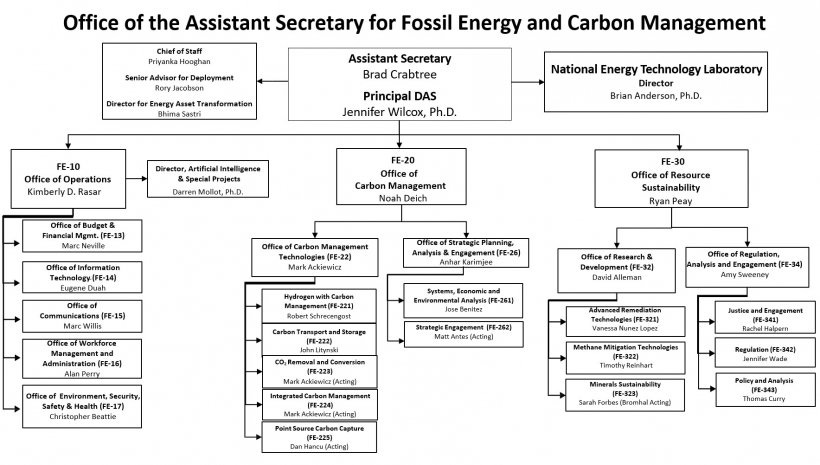
We’re all familiar with org charts. Investopedia tells us an organizational chart is, “a diagram that visually conveys a company’s internal structure by detailing the roles, responsbilities, and relationships between individuals within an entity.” They all typically look like the one above.
I don’t mean to pick on the Department of Energy, but let’s examine this diagram, which is representative of most org charts. Notice the arrows are one-way. Assistant Secretary Brad tells the Chief of Staff, but I guess the Chief of Staff doesn’t offer any feedback because the arrow doesn’t go that way. Everything flows from the top down. Also notice if Chris in FE-17 needs something from Dan in FE-225, he needs to go up a level, over to another silo, and down two levels.
In healthy organizations, it doesn’t work this way. People throughout the enterprise routinely work together, coordinate issues, and help one another so the actual diagram would show just about everyone connected to everyone else. Such a chart actually capturing the “internal structure by detailing roles, responsibilities, and relationships” might be extremely useful, but could be quite busy.
The standard org chart is a boss chart. If considered as such and accompanied by an actual systems architecture, I have no problem with it. But in some organizations, the boss chart is interpreted as the working architecture. “I can’t help you unless you go through my boss.” “Nobody emails a boss unless the gatekeepers ok it first.” “Nobody can recruit except the recruiter.” If FE-17 and FE-225 have a meeting, everyone in between must sign off first and attend. Not very efficient is it?
Everything you put out to customers, employees, and others should have a purpose. What’s the purpose of a boss chart? To define empires? To stroke egos? To further bureaucracy?
Might it be better to use a network diagram, venn diagram, or something similar to convey how the organization really works or should work? Would a structure that facilitates adaptivity, creativity, and collaboration be better than a rigid hierarchy?
Image: US Department of Energy